As part of our study of the Roaring Twenties, a number of students attempted to learn how to dance the Charleston, the most popular dance of that decade. All of the students who tried the dance did great and everybody had fun, even those who decided to simply watch.
I posted the video that I made below. Don't forget to post your comments.
Wednesday, September 30, 2009


Monday, September 28, 2009
The Charleston
Today in class we compared the two songs Charleston Party (which characterized the mood of the 1920's) and Brother Can You Spare a Dime (which characterized the mood of the 1930's).
The instructional videos below explain how to do the Charleston, the most popular dance of the 1920's. Learn how to do this dance and we will perform it in class later this week. Anyone who participates in the dance (no matter how good you are at it) will earn extra credit.
The instructional videos below explain how to do the Charleston, the most popular dance of the 1920's. Learn how to do this dance and we will perform it in class later this week. Anyone who participates in the dance (no matter how good you are at it) will earn extra credit.
Sufferin' Till Suffrage
The roles that women played in America during the first World War helped lead to the adoption of the 19th Amendment. If you don't remember what that was all about, here's a video that might help:
Friday, September 18, 2009
Wednesday, September 16, 2009
Current Events Analysis Form
Due to popular demand, I have uploaded a copy of the weekly Current Event Analysis form. There is a link to it on the side-bar under "documents".
Tuesday, September 15, 2009
Immigration Poll
Since we are currently discussing the issue of immigration in U.S. today, I have added a poll about this issue to the side-bar. All responses are anonymous, so feel free to vote your conscience without having to explain anything. We'll discuss the final results in class next week.
Thursday, September 10, 2009
Wednesday, September 09, 2009
Friday, September 04, 2009
Tuesday, September 01, 2009
NP Social Studies on Twitter
I have set up a Twitter account (@npsocialstudies) for our class! I will use this to post updates on what is going on in class, homework assignments, and more. You will also be able to read my Tweets on the sidebar of this blog.
Go to Twitter.com/npsocialstudies to find out more.
Go to Twitter.com/npsocialstudies to find out more.
Extra Credit - Interview Questions
To help us better understand what the experience of immigration is like, I am going to interview someone who immigrated to the United States using questions submitted by students. I will then post the interview on this blog and we will watch it in class.
I will give extra credit to students who submit questions for the interview. To participate, simply write your name, core, and question on a 3x5 index card and turn it in to me by this Friday (Sept. 4th).
I will give extra credit to students who submit questions for the interview. To participate, simply write your name, core, and question on a 3x5 index card and turn it in to me by this Friday (Sept. 4th).
Wednesday, August 12, 2009
Welcome Back
To welcome you back, here are some videos about the first day of school:
And you may remember this one from the first day of Social Studies last year:
I'm very excited to be teaching 8th Grade Social Studies. While everything will be new to you this year, remember that it will also be new to me. I have never taught
8th grade, or this time-period before, so I am very excited about trying new things.
the curriculum will cover modern American history and Current Events. Here are a couple of videos that will serve as preview of what our focus will be this year:
Saturday, June 06, 2009
The End
I just wanted to let everyone how much I've enjoyed this year. As I mentioned at our awards ceremony, this has been one of my favorite groups of 7th graders that I've had here at North Prairie. I hope that you have learned a lot about our country's history and that you had fun doing so.
Enjoy your summer!
Enjoy your summer!
Friday, April 24, 2009
Tuesday, April 21, 2009
Math in Social Studies???
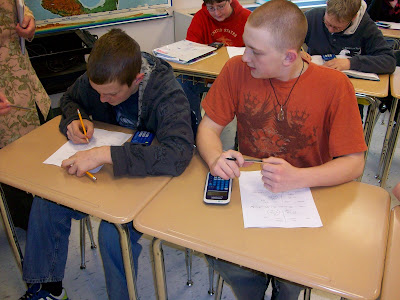
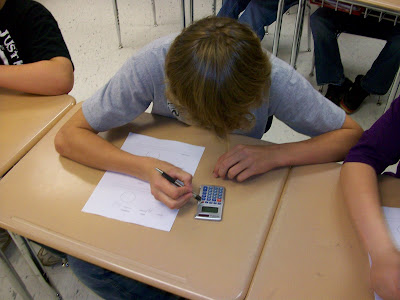
In order to better understand the differences between the Union and Confederacy at the start of the Civil War, we looked at the major resources for each side. Students took the amounts that each side had of each of these resources and converted them into percentage so that they could create pie-graphs showing the difference between them.


A Dividng Nation
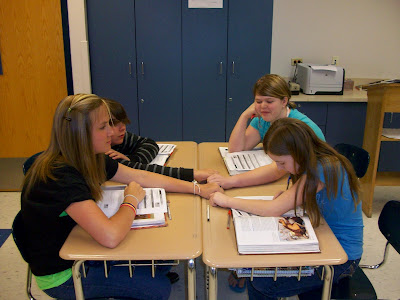
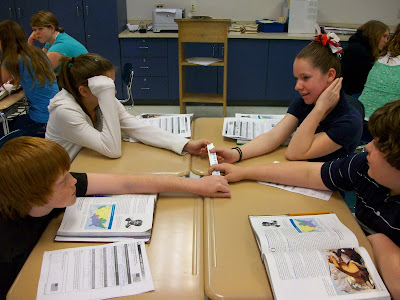
Recently, students played the role of U.S. Senators in the first half of the
1800's. Some of them represented the North and some represented the South. They had to make compromises in order to keep the country together as issues such as slavery in the territories, the Dred Scott case, the Kansas-Nebraska act and the election of 1860 threatened to tear the country apart.
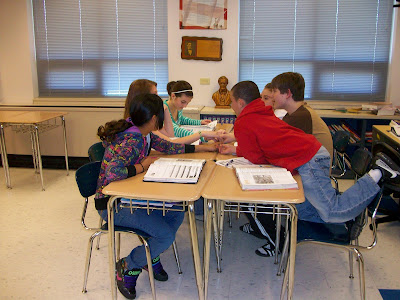
1800's. Some of them represented the North and some represented the South. They had to make compromises in order to keep the country together as issues such as slavery in the territories, the Dred Scott case, the Kansas-Nebraska act and the election of 1860 threatened to tear the country apart.


Monday, April 20, 2009
Monday, April 13, 2009
Subscribe to:
Posts (Atom)